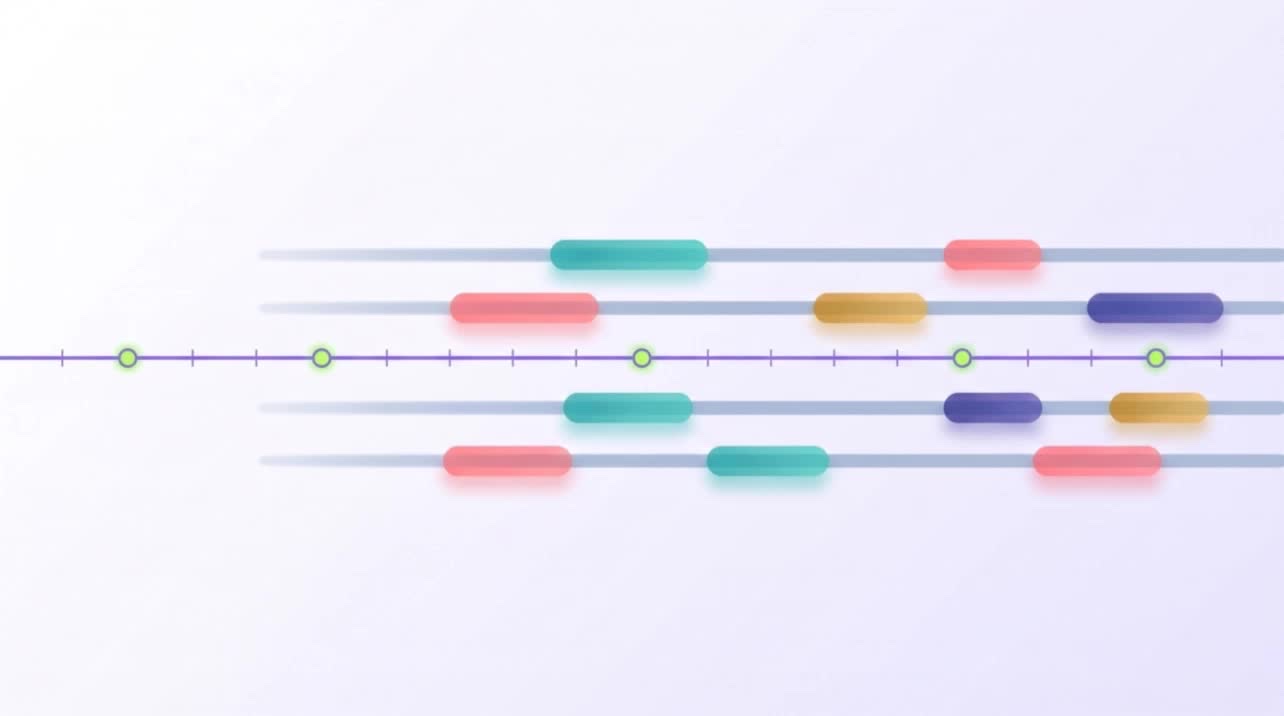
Parallel lanes
What was happening at the same time
Two countries, two artists, two fronts: each in its lane, on the same axis. Coincidences show up without looking for them.
Open full timelineType a subject. An agent gathers the dated facts, checks them and draws it for you.
5 free timelinesthe first one without an accountdates verified on Wikipedia
What it's for
You place each fact against the others, see what was happening at once, and where the silences are.
Parallel lanes
Two countries, two artists, two fronts: each in its lane, on the same axis. Coincidences show up without looking for them.
Open full timelineProportional axis
The distance between two facts is the time that passed between them. That's how you get your bearings: what came first, how long it lasted, where it went quiet.
Open full timelineFrom millennia to days
Zooming changes the unit: millennia, centuries, years, days. And any fact can be opened as its own timeline.
Open full timelineSources and a link
Each fact is checked against Wikipedia: verified ones carry their article and the rest are flagged. You share a link, not a screenshot.
Open full timelineA whole unit on one axis: what happened, in what order, and what was going on at once.
A script with verified dates and a picture ready for your explainer.
Discographies, careers and seasons, with the quiet years in plain sight.
The chronology of a case, with the source of every date.
Pricing
A timeline is one request with its axis. Checking your subject, opening, sharing and exporting are free.
To try it
USD 0
5 timelines
Try it with whatever you're curious about. The first one needs no account.
Start for freeOne-time
Best price per timeline
Subscription
USD 9.99a month
100 timelines≈ USD 0.10 per timeline
If you use it every week: teachers, creators, research.
BuyDrilling into a fact as its own timeline counts as one. Prices in US dollars; taxes depend on your country. Refunds · Terms
FAQ
A chatbot gives you text with dates you have to take on faith. Here every date goes through a validation without AI (format, lane, range, duplicates) and is checked against Wikipedia; whatever can't be verified is flagged. And what you get is a proportional axis with lanes, zoom down to the minute and a link to share, following the same rules as the Timelines apps.
In four steps. It checks whether your request can be a timeline. It generates the facts with the date as it is known. It validates dates, lanes and units without AI: if something fails, it goes back to the model to be fixed, never filled in. And it verifies each reference against Wikipedia.
It never invents a date: if only the year is known, you get the year, and estimates are marked as approximate. Each fact carries its Wikipedia article when one exists, with an extract and a link, and the ones that couldn't be verified are flagged. If you're going to publish it, check the sources.
Before generating, the agent tells you whether it can be a timeline, proposes the closest thing, or explains why not. You confirm before anything is spent, and that check doesn't count.
Not for the first one: you make it without signing up. To keep going, you create your account; it keeps what you already made and you have 4 of the 5 free ones left.
Every timeline that gets generated, and every time you drill into a fact as its own timeline. Checking a request, opening, sharing and exporting are free.
You decide for each one: private (only you), with link (anyone who has it; that's the default) or public.
Yes: as an image, printed or saved as PDF, and the data as CSV or JSON.
The site is in Spanish and English. Each timeline is generated in the language you ask in, and isn't translated afterwards.
You can add a top-up of 25 or 50, or move to the 100-a-month plan, which is cheaper per timeline. Paddle processes the payment; when you come back to Account you see the new cap (for example 3 / 100).
Type the subject and see what happened, when, and what was going on at the same time.